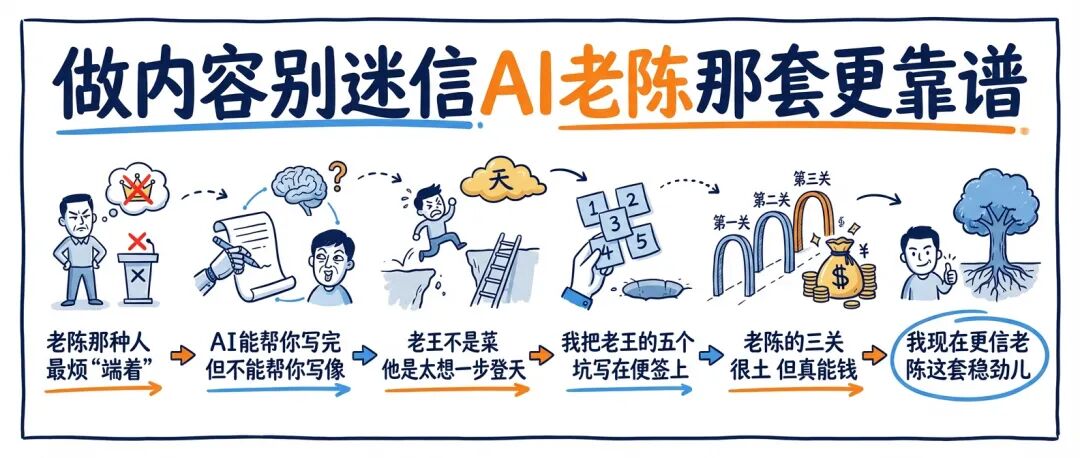
Last week I met up with a friend who runs corporate accounts. He was scrolling through his phone and grumbling: "What clients hate most now is content that screams AI — opening with 'in this day and age' and closing with 'in conclusion'." I told him that's still mild. I've seen worse — a client threw a draft back: "Did you just use ChatGPT as an intern and then forget about it?"
That remark pulled me back to two personas I know well: one is Old Chen, the other is Old Wang. Old Chen has spent twenty years in publishing, his face etched with "reality has beaten me hard." Old Wang comes from a big-tech PM background, his approach is "either don't do it, or build a platform." Both use AI, but the paths they've taken are almost two different destinies.
01 People Like Old Chen — Hate "Putting on Airs"
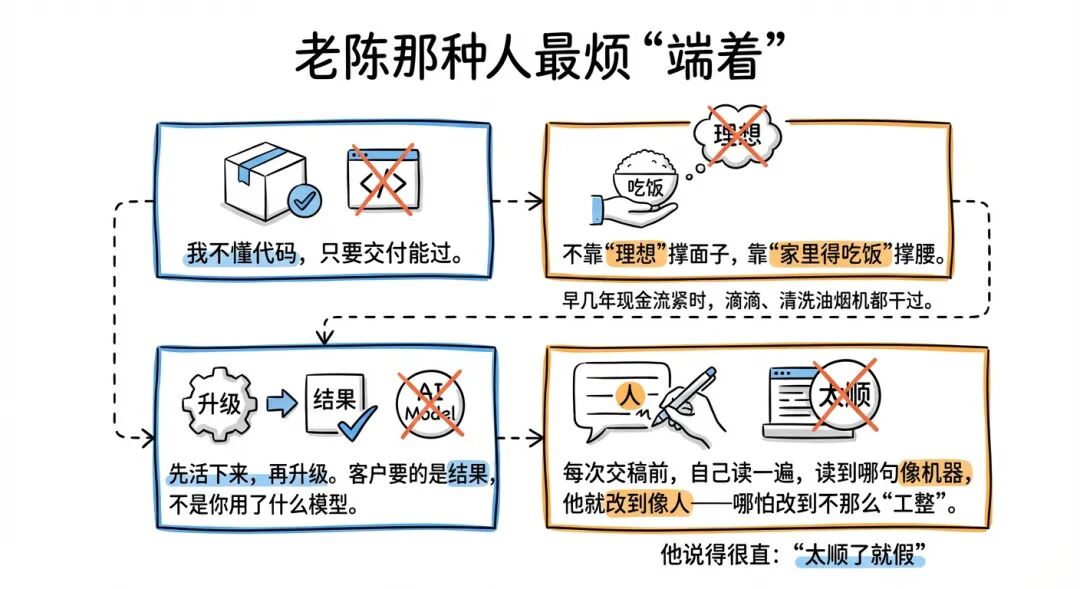
The first time Old Chen talked to me about AI writing, his words were plain: "I don't understand code, and I don't want to. I just need deliverables that pass." Sounds trivial, but when you actually put that into action, you realize how solid it is.
Back when his cash flow was tightest, he drove for Didi, cleaned kitchen exhaust hoods — all of it. Saying it out loud isn't shameful; it's actually dignified. He doesn't prop up face with "ideals," he props up backbone with "the family needs to eat."
I've seen plenty of content people who, once they encounter AI, start to float: thinking they can become a content factory overnight. Not Old Chen. His logic: survive first, upgrade later. If there's work to take, take it; if there's a delivery to make, make it. Clients want results, not which model you used.
He has one habit I really admire: before submitting a piece, he reads it out loud once. Wherever a sentence sounds like a machine, he revises it to sound human — even if it becomes less "polished." He puts it bluntly: "Too smooth feels fake, too standard feels boring."
02 AI Can Help You Finish Writing — But Not Write Like You
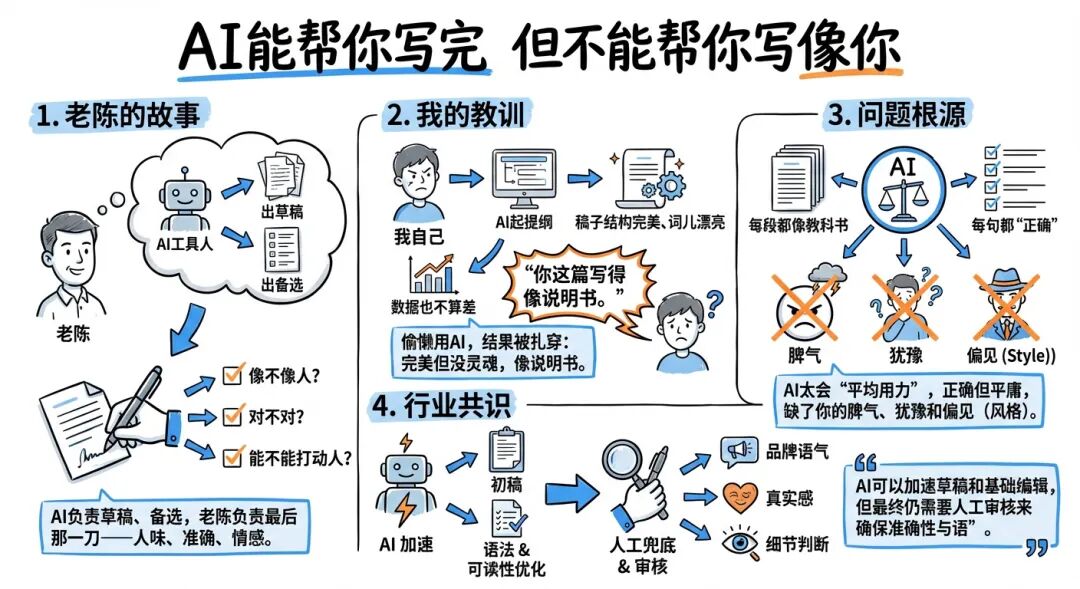
Old Chen treats AI as a "tool person": AI handles drafts and alternatives; he handles the final cut — does it sound human, is it right, can it move people.
I've learned this the hard way myself. Once I got lazy and used AI to generate an outline. The structure was perfect, the wording was polished, the data wasn't bad after publishing — but someone in the comments cut right through: "This reads like an instruction manual."
Where did it go wrong? AI is too good at "evenly distributing effort": every paragraph reads like a textbook, every sentence is "correct," but there's no temper, no hesitation, no bias (yes, sometimes bias is what makes a style).
Articles by content editors also make this clear: AI is good for first drafts, grammar, and readability optimization, but brand voice, authenticity, detail judgment — that's still on you.
"AI can accelerate drafting and basic editing, but final review by humans is still required to ensure accuracy and consistent tone." — Optimizely, AI for content editing
https://www.optimizely.com/insights/blog/ai-for-content-editing/
"Treat AI as a starting point, not an endpoint; you need to layer your judgment and context onto its output." — VisibleThread, Maximizing AI's potential in content creation
https://www.visiblethread.com/blog/5-top-tips-for-maximizing-ais-potential-in-content-creation/
Old Chen's "de-AI-ification" isn't mystical — it's three pieces of hard, unglamorous work:
Fact-checking: names, data, policies, timelines — verify everything.
Emotional polish: which sentence should hold back, which should hit harder — someone needs to feel it.
Quotable hooks: one line people will share isn't "therefore we can see that."
AI can help with these three, but it can't take responsibility. Especially fact-checking — when AI "confidently hallucinates," you take the blame. Emotional polish is even worse; what really makes people stop and read is often imperfect phrasing, a bit of personal history, a tilt of bias.
Later I learned from Old Chen: after writing, read it aloud once. If it doesn't flow, delete it. If it sounds like "PR copy," rewrite it. The most effective de-AI-ification tool turned out to be — my mouth.
"Common issues with AI text are overly generic tone and lack of human rhythm; editing should add personal detail and natural expression." — Proofed, 6 tips for editing AI-generated content
https://proofed.com/knowledge-hub/6-tips-for-editing-ai-generated-content/
03 Old Wang Isn't Bad — He Just Wants to Skip Straight to the Top
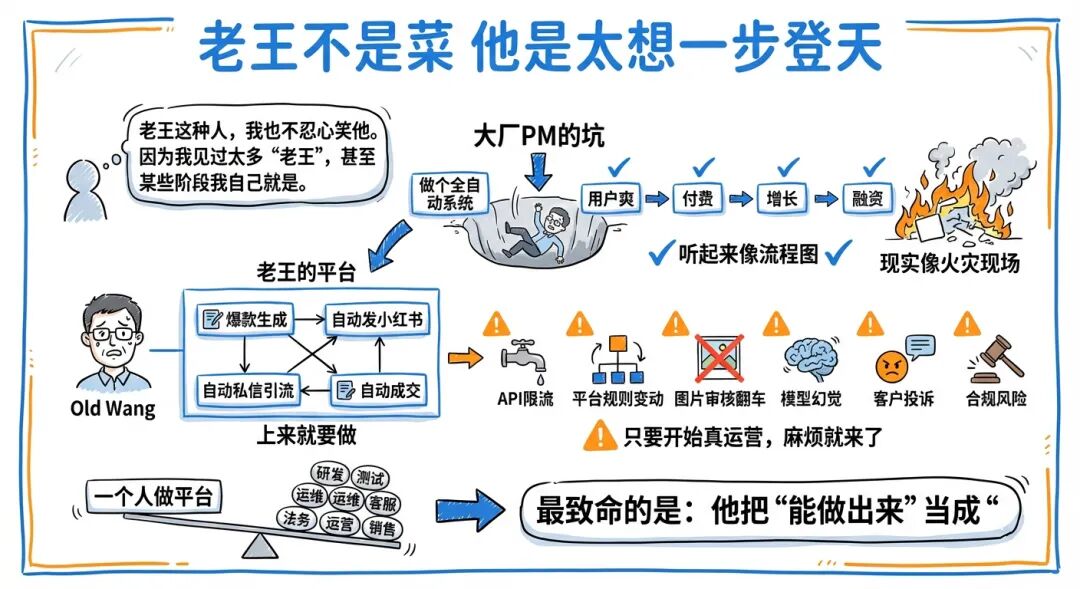
I don't have the heart to mock Old Wang. Because I've met too many "Old Wangs," and at certain stages, I've been one myself.
Big-tech PM thinking easily slips into one pit: I'll build a fully automated system first; users come in, they should be delighted; once delighted they should pay; once paying they should grow; once growing they should get funded. Sounds like a flowchart, looks like a fire scene in reality.
Old Wang went straight for a platform that would "generate viral content + auto-post to Xiaohongshu + auto-DM leads + auto-close sales." The tech stack was impressive, the demo looked slick — but as soon as real operations started, trouble came: API rate limits, platform rule changes, image review failures, model hallucinations, customer complaints, compliance risks… It's not that platforms can't be done — it's that doing a platform alone means simultaneously being R&D, QA, ops, customer service, legal, operations, and sales.
Most fatal of all: he mistook "can build it" for "can sell it." I've stepped in that trap too — when you build a feature, the sense of accomplishment is explosive; but when you need people to keep paying, you realize the feature is only 1%, the other 99% is delivery experience, stability, trust, and after-sales.
There's a trend I agree with: the AI world has moved from "hot-blooded rush" back to "pragmatic reality check." It's not that AI doesn't work — it's that thinking you can coast on automation easily gets you pinned to the ground by reality.
"AI is moving from hype to pragmatism; the real challenge is embedding capability into stable products and business." — TechCrunch (2026 trend article)
https://techcrunch.com/2026/01/02/in-2026-ai-will-move-from-hype-to-pragmatism/
Old Wang has another problem: he loves chasing hot trends and pivoting. Image-text hasn't worked yet, so he rushes into AI-avatar videos; computing resources cost tens of thousands — and by then the market has shifted, while he's still fixing bugs. In the end, he's firefighting 16 hours a day, the more he fights the more panicked he gets, and the more panicked he gets, the more he wants to "add one more feature to turn things around."
Let me say something harsh: what solo developers fear most isn't insufficient tech — it's "lack of clarity." People without clarity love building platforms.
04 I Wrote Down Old Wang's Five Pitfalls on a Sticky Note
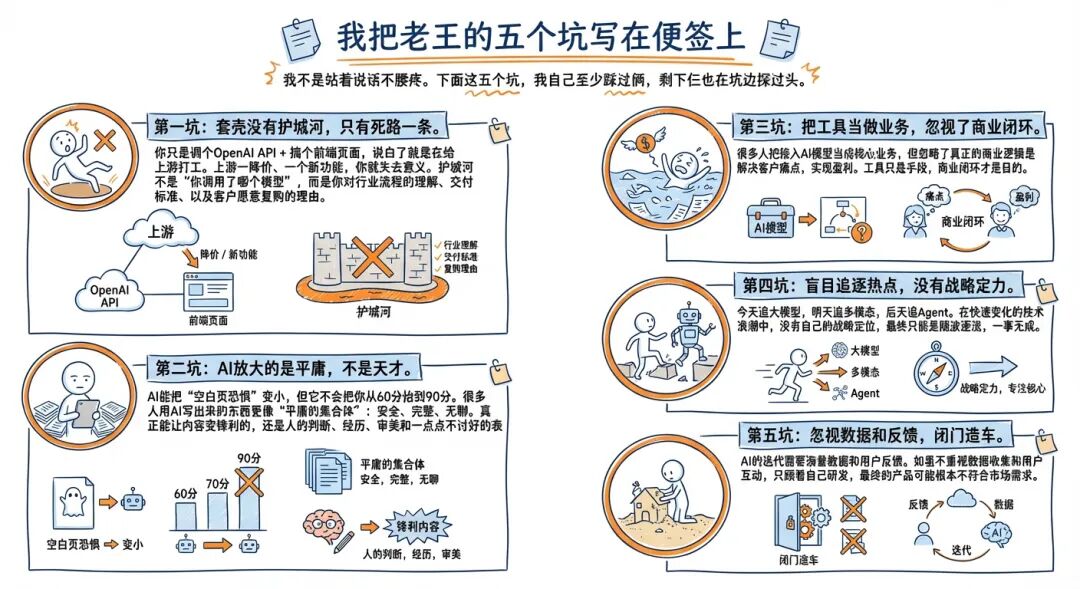
I'm not speaking from a high horse. Of the five pitfalls below, I've stepped in at least two myself, and peeked into the others.
First pit: Wrappers have no moat, only a dead end.
You're just calling an OpenAI API + wrapping it in a frontend. Bluntly put, you're working for upstream. When upstream drops prices or adds a feature, you lose relevance. A moat isn't "which model you call," it's your understanding of the industry workflow, delivery standards, and why customers want to repurchase.
Second pit: AI amplifies mediocrity, not genius.
AI can reduce "blank page fear," but it won't lift you from 60 to 90 points. Many people using AI produce what's more like "a collection of mediocrity": safe, complete, boring. What really sharpens content is still human judgment, experience, taste, and a bit of unpleasant honesty.
"AI output tends to be more 'generic'; without editing, it easily becomes content lacking uniqueness." — Patiyer (AI content editing advice)
https://patiyer.com/2025/12/editing-ai-generated-content-tips-for-people/
Third pit: The biggest enemy of a one-person company is scattered energy.
A one-person company isn't "one person doing a team's work," it's "one person only doing the most critical thing." If you simultaneously do product, write content, run ads, manage community, do customer service — you're basically committing slow suicide. Worse: you're too busy to think, "What problem am I actually solving for whom?"
Fourth pit: Don't start a business for technology — start for a problem.
When all you have is a hammer, everything looks like a nail. Old Wang is a classic case: first figure out how to use AI, then find a scenario. The correct order should be reversed: first find a problem that keeps customers up at night, then see if AI can solve it cheaply, stably, and controllably. Otherwise, what you build is just your own self-indulgence.
"AI is better suited to solving clear business problems, not AI for AI's sake." — U.S. Chamber of Commerce (AI and business strategy)
https://www.uschamber.com/co/start/strategy/ai-content-generation
Fifth pit: Don't treat the office like a romantic drama set.
This one is what Old Wang himself said after crashing. I won't elaborate. Adults — control yourself, don't add side quests to your life.
05 Old Chen's Three Gates — Down-to-Earth, But They Actually Make Money
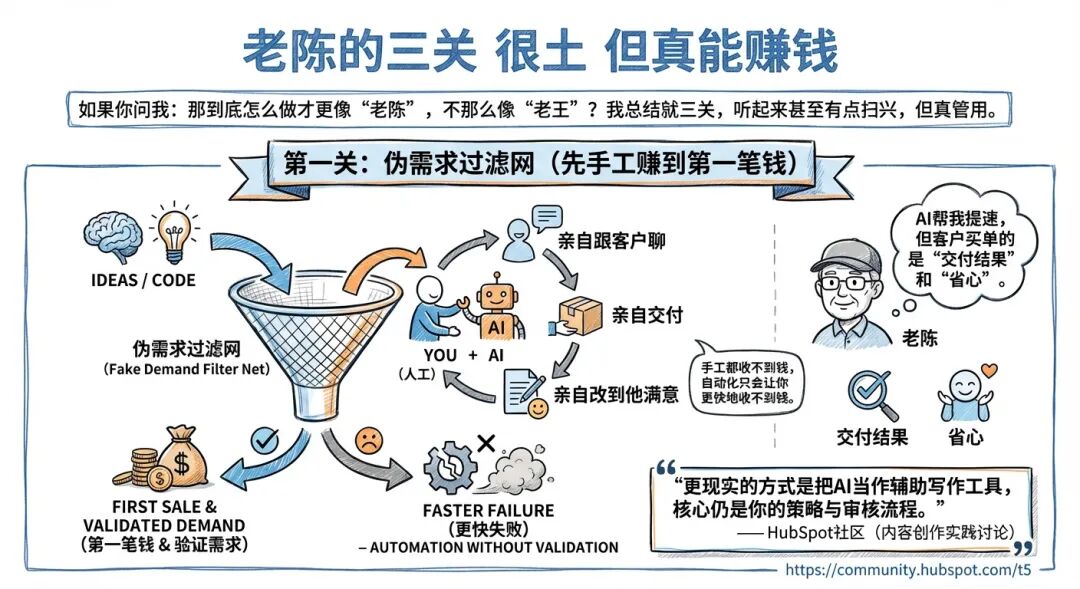
If you ask me: so how do you become more like "Old Chen," less like "Old Wang"? I'd sum it up in three gates. They sound almost disappointing, but they really work.
First gate: Pseudo-need filter (earn the first dollar manually first).
Before writing code, manually serve the first client with "human + AI." You talk to the client yourself, deliver yourself, revise until they're satisfied. If you can't make money manually, automation will just help you fail to make money faster.
That's exactly what Old Chen did: AI helps him speed up, but what clients pay for is "delivery results" and "peace of mind."
"A more realistic approach is to treat AI as an assistive writing tool, with core strategy and review workflow still yours." — HubSpot Community (content creation practice discussion)
https://community.hubspot.com/t5/Tips-Tricks-Best-Practices/Navigating-Content-Creation-in-the-World-of-AI/m-p/887190
Second gate: Tech minimalism (don't think you're an infrastructure company).
Don't self-develop a large model, don't start by self-hosting server clusters. If you can build it with tools, build it with tools first — get delivery running smoothly first. Your real asset is: workflow, prompt library, industry knowledge, delivery SOP, and your understanding of clients. Code gets outdated, business understanding doesn't.
I love one saying: your system isn't written, it's "polished" by customer needs. Old Chen's prompts weren't written in one go — they were forced out by countless revisions.
"AI tools can boost efficiency, but embed them into clear processes and quality control." — Docebo (Generative AI in content production)
https://www.docebo.com/learning-network/blog/generative-ai-in-content-creation/
Third gate: Cash flow red line (don't dream of being saved by funding).
Don't hire without positive cash flow; don't prepay a bunch of services for "future potential demand"; don't bet your living expenses on "the product will blow up next month."
The essence of a one-person company is an upgraded version of freelancing: it's a business first, then talk about being a company.
Old Chen's foundation is really just one line: AI makes me more efficient, but the critical cut must be mine. Because that cut is reputation, repeat business, whether you dare take responsibility for the client.
"When editing AI content, humans bear final responsibility: accuracy, tone, compliance, and risk control." — Growth Memo (AI content editing workflow)
https://www.growth-memo.com/p/how-i-edit-ai-content
06 I Trust Old Chen's Steady Approach More Now
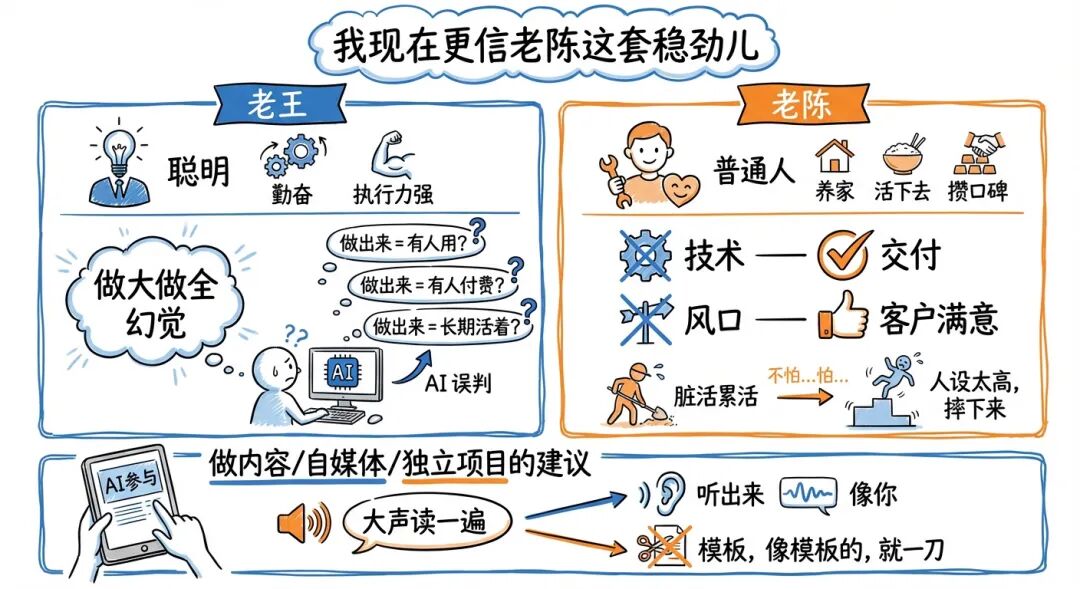
By this point, I'm not trying to paint Old Wang as a cautionary tale. People like Old Wang are actually quite common: smart, hardworking, strong execution — they're just too easily carried away by the illusion of "building big and comprehensive." Especially since AI has made "building something" so easy, people misjudge more easily: thinking building it equals people using it, equals people paying, equals long-term survival.
I lean more toward Old Chen, not because he's more "correct," but because he's more like a regular person: he has to support his family, survive, build reputation. He doesn't idolize technology, he idolizes delivery; doesn't chase trends, chases customer satisfaction; isn't afraid of dirty, hard work — what he fears is holding his persona too high and falling.
If you're also doing content, self-media, indie projects, I suggest you do one very down-to-earth thing today: read aloud a recent piece where "AI participated." You'll quickly hear which parts sound like you, which parts sound like templates. The template parts — cut them with one stroke.
Finally, I want to ask you a question: are you more like Old Chen, or more like Old Wang? What pitfalls have you stepped in, and how did you climb out? Chat in the comments — I want to hear the real stuff, not success stories.
Source List
Optimizely: https://www.optimizely.com/insights/blog/ai-for-content-editing/
VisibleThread: https://www.visiblethread.com/blog/5-top-tips-for-maximizing-ais-potential-in-content-creation/
Proofed: https://proofed.com/knowledge-hub/6-tips-for-editing-ai-generated-content/
Patiyer: https://patiyer.com/2025/12/editing-ai-generated-content-tips-for-people/
HubSpot Community: https://community.hubspot.com/t5/Tips-Tricks-Best-Practices/Navigating-Content-Creation-in-the-World-of-AI/m-p/887190
Docebo: https://www.docebo.com/learning-network/blog/generative-ai-in-content-creation/
Growth Memo: https://www.growth-memo.com/p/how-i-edit-ai-content
TechCrunch: https://techcrunch.com/2026/01/02/in-2026-ai-will-move-from-hype-to-pragmatism/
U.S. Chamber of Commerce: https://www.uschamber.com/co/start/strategy/ai-content-generation