Resignation Series <1/3> — Leveling the Playing Field
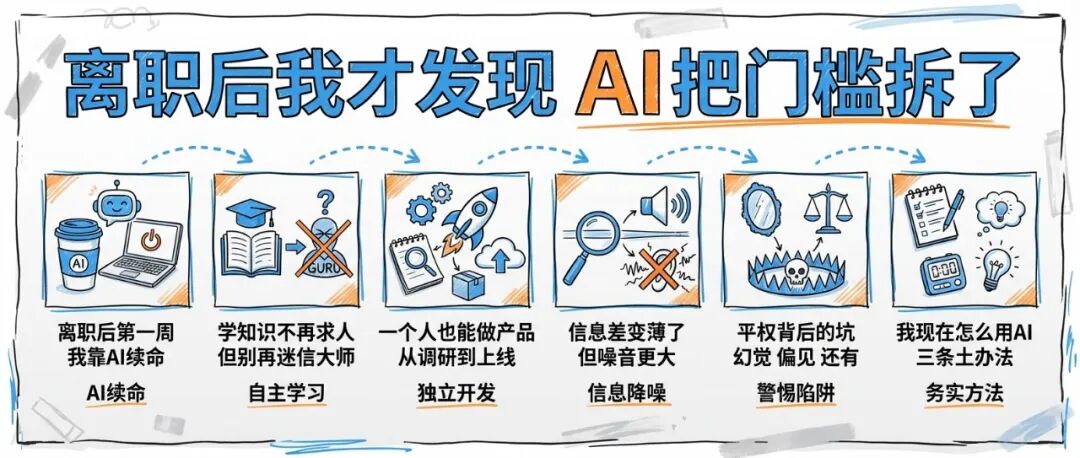
The day I quit, I walked home with my laptop feeling pretty defiant: "I'm done. I want freedom." Then I got home, woke up at 5:30 the next morning, and the anxiety hit—no desk, no colleagues, no one dragging me into meetings, and my bank balance wouldn't magically grow just because I was "self-actualizing."
The realest state I was in those first few days: anxious on one hand, clinging to an AI chat window like a life raft on the other. Not the "the future is here!" kind of excitement—more like a drowning person who just grabbed onto a plank: turns out a lot of things that used to require begging people, assembling teams, or spending money, I could now push forward on my own, with just a laptop and an internet connection.
Later I slowly realized, my biggest feeling about AI wasn't that I got "stronger"—it was three words: lower barriers. Or you could even say, a kind of leveling the playing field.
01 First Week After Quitting: My Discovery About AI!
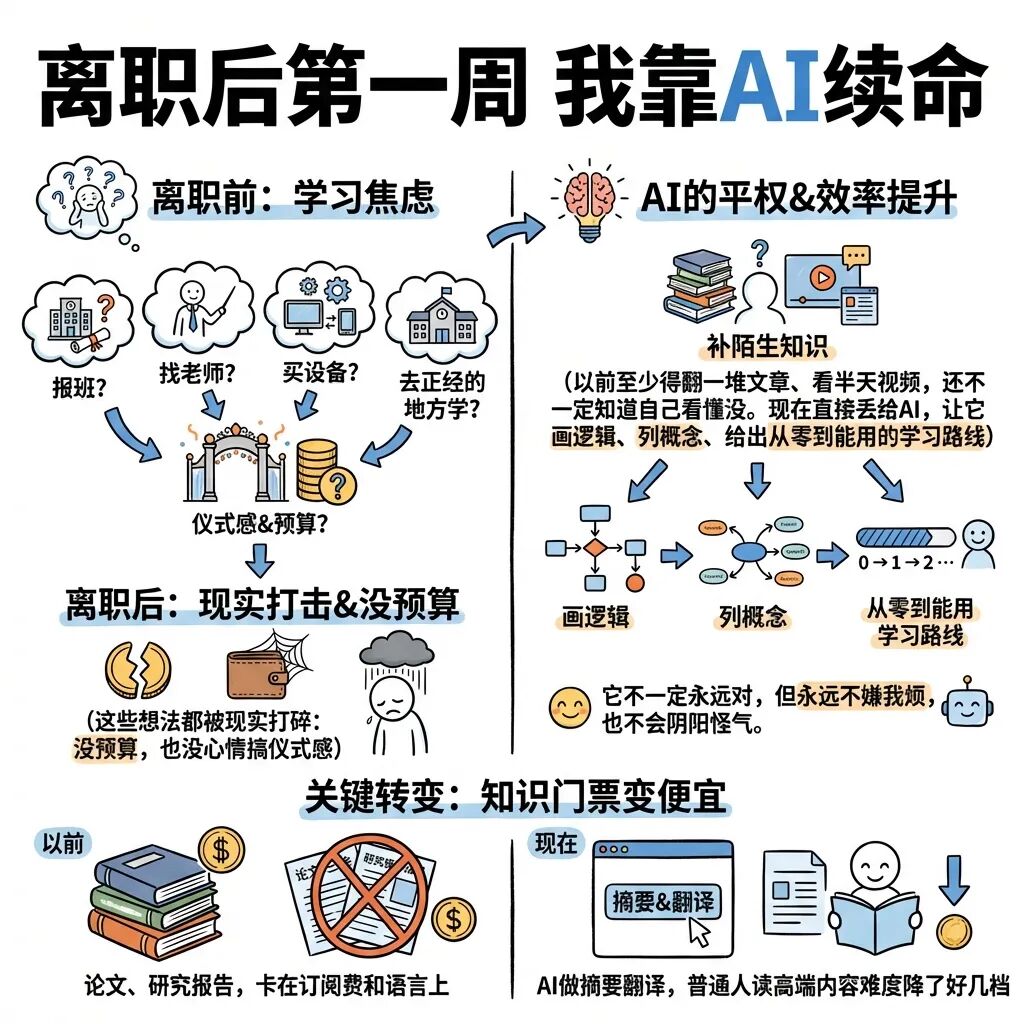
Before I quit, I was pretty timid about "learning." Wanting to learn something new, I'd always think first: should I sign up for a class? Find a teacher? Buy equipment? Go somewhere proper to learn?
After quitting, reality smashed all those thoughts: I had no budget, and no mood for those rituals.
The first time I strongly felt AI's "leveling the playing field" was in a tiny scenario: I wanted to quickly pick up knowledge in an unfamiliar area (the business-y kind). Before, I'd have to dig through a pile of articles, watch videos for ages, and still not know if I understood. Now I just toss the parts I don't get to AI, have it draw the logic, list concepts, and give me a "from zero to usable" learning roadmap while it's at it.
It's not always right, but it never gets annoyed with me, and never passive-aggressively says "you don't even know this?"
More crucially, the "ticket price" for knowledge is getting cheaper. Before, many papers and research reports were blocked by subscription fees and language—ordinary people would never pay for an entire database just to answer one question. Now open access (OA) is increasingly common anyway, and with AI doing summaries, translations, and recommendations, the difficulty for ordinary people to read "seemingly high-end" stuff has dropped several notches.
"Over 50% of scholarly articles are now freely available through open access and similar means... AI is accelerating research dissemination and collaboration." — Integranxt (citing UNESCO 2023 trends) [https://integranxt.com/blog/ai-and-the-future-of-open-access-publishing-revolutionizing-academic-research-and-dissemination/]
I don't want to make this sound too grand—for me it's a very practical thing: before I had to first find the "door," now the door is right in front of me, with instructions included.
02 Learning Knowledge Without Begging People—But Stop Worshipping Gurus
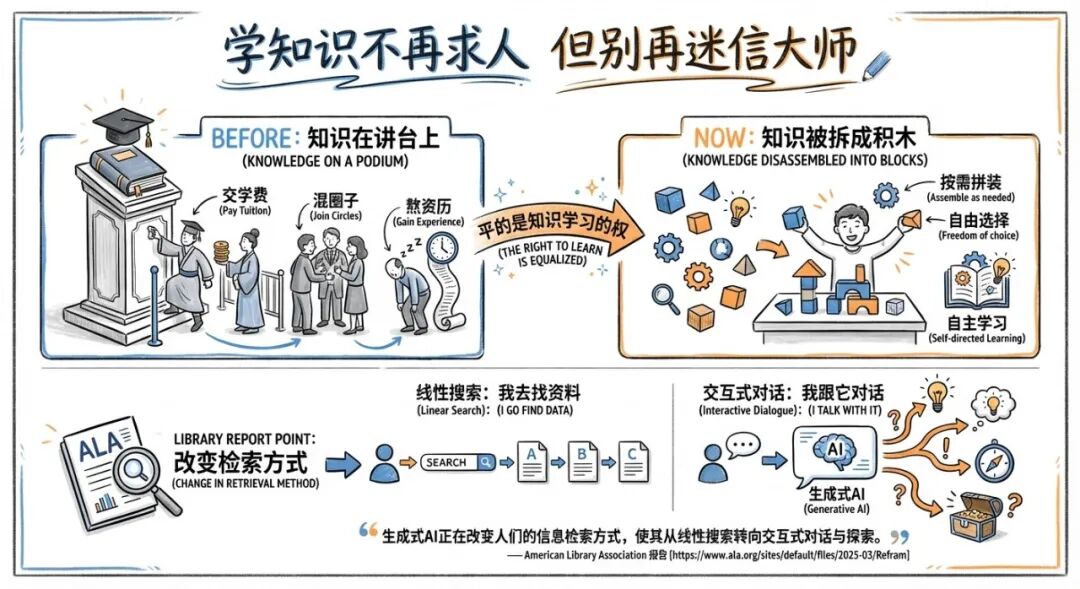
"What's being leveled is the right to learn knowledge"—this phrase, I now really feel in my bones: before, knowledge was like it was placed on a podium, you either paid tuition, mixed in circles, or grinded seniority. Now knowledge is more like it's been broken into building blocks, you can assemble it according to your own needs.
People in library systems wrote a report, there's a point I really like: generative AI is changing information retrieval from "I go find materials" to "I chat with it," the path is no longer linear, it even goes down forks you never thought of.
"Generative AI is transforming how people retrieve information, shifting from linear search to interactive dialogue and exploration." — American Library Association report [https://www.ala.org/sites/default/files/2025-03/ReframingInformation-SeekingintheAgeofGenerativeAI.pdf]
But I've also stepped on landmines: AI explains things too smoothly, so smooth it makes me think "I get it." Later when I went to check original materials I discovered it had mushed two concepts together—sounded reasonable, but was actually wrong. In that moment I suddenly understood: the right to learn has been leveled, but truth hasn't been leveled.
There's an even more brutal thing: the "authority structure" of knowledge is changing. Before you had to listen to teachers, read textbooks, pass exams—at least there was a filtering mechanism. Now you scroll to whatever, ask whatever, AI gives you whatever, you learn whatever—it easily becomes "demand-driven knowledge": I want a conclusion, it gives me a conclusion.
This is great for efficiency, in the long run it might also lead you astray.
"AI and big data are compressing the bottom layers of 'Data-Information-Knowledge-Wisdom (DIKW),' giving rise to demand-oriented knowledge paths; but may also produce polluted knowledge legitimized by 'popularity.'" — Journal of Futures Studies Digital (JFS Digital) [https://jfsdigital.org/2025-2/vol-30-no-1-september-2025/on-the-crisis-and-democratization-of-knowledge-the-sociopolitical-impact-of-ai-and-knowledge-hierarchy/]
So my current attitude toward "knowledge democratization" is: it really has torn down barriers, but it's also thrown the responsibility of "proving yourself right" back at you. You have to learn not to worship blindly, especially don't worship AI that outputs super confidently with super smooth sentences.
03 One Person Can Build a Product—From Research to Launch
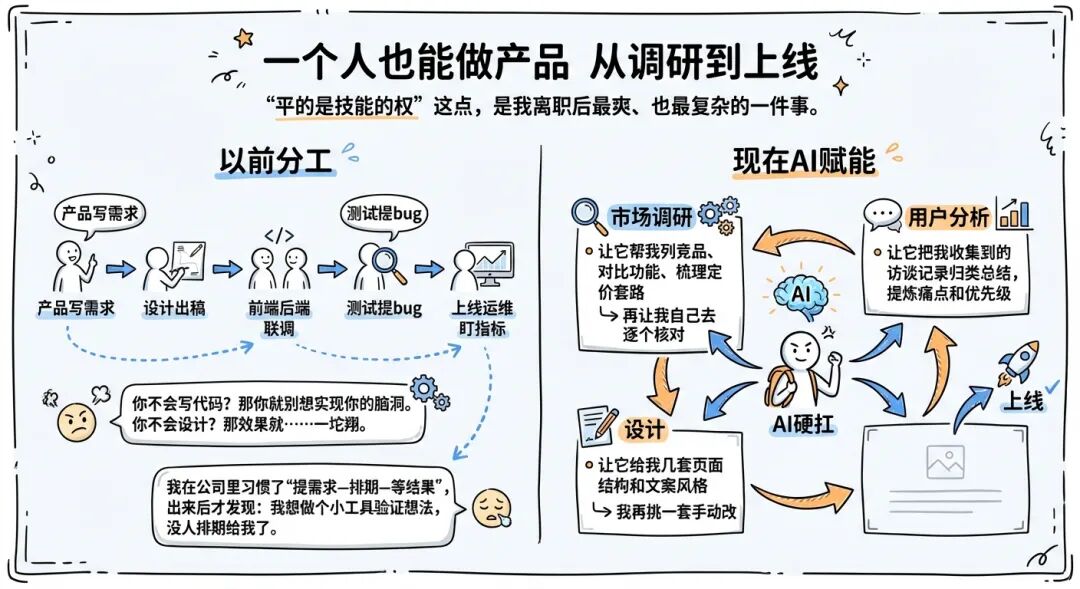
"What's being leveled is the right to skills"—this point is the most satisfying and most complex thing after I quit.
Before, work was very about division of labor: product writes requirements, design outputs drafts, frontend and backend coordinate, testing files bugs, launch ops monitor metrics. You can't code? Then forget about implementing your wild ideas. You can't design? Then the result is... a pile of crap.
At the company I got used to "submit requirements—schedule—wait for results," after leaving I realized: I want to build a small tool to validate an idea, no one's scheduling it for me anymore.
So I started using AI to tough it out:
Market research: have it list competitors for me, compare features, sort out pricing patterns, then I verify each one myself;
User analysis: have it categorize and summarize interview records I collected, extract pain points and priorities;
Design: have it give me a few sets of page structures and copy styles, I pick one and manually modify it;
Development: parts I don't know I have it write demos, I'm responsible for stitching them together to run;
Testing: have it list test cases and edge conditions for me;
Deployment: follow the scripts it gives step by step to get it on the cloud.
After this whole process, my biggest feeling wasn't "I became full-stack," but: things that used to require a small team to push forward, now one person can reach 60 points, even hit 80 points in some areas.
The skill barrier really has been flattened.
"Generative AI is lowering professional thresholds, enabling individuals to complete research and creation workflows (like literature reviews, creative generation, etc.) that previously required teams, but still need human oversight and methodological constraints." — Cornell Research & Innovation [https://www.research-and-innovation.cornell.edu/generative-ai-in-academic-research/]
But I also have to pour cold water: AI has made "being able to do it" easier, but "doing it well" is still very hard. Especially with products, you can write the code, doesn't mean people will use it; you can make the pages, doesn't mean retention. AI can push you from 0 to 1, but from 1 to 10, a lot of times you gotta take the beatings yourself.
Now I actually respect more those who can do "requirements—solution—tradeoffs—implementation—review" solidly. AI is like a more powerful tool, but it doesn't bear the cost of your tradeoffs.
04 Information Gaps Thinned—But Noise Got Louder
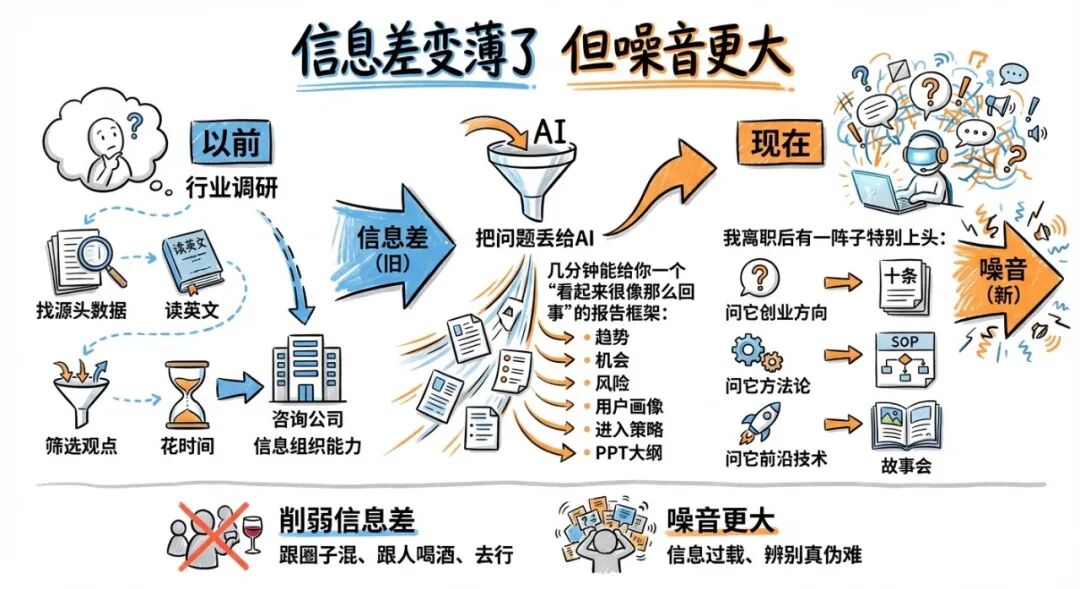
The third "leveling the playing field" I think hits hardest: the right over information gaps.
Before, to write a decent industry research report, you had to know how to find source data, read English, filter viewpoints, and spend time. What many consulting firms sell, essentially, is "information organization ability."
Now? You throw the question to AI, in a few minutes it can give you a "looks pretty legit" report framework: trends, opportunities, risks, user personas, entry strategies... even arranges the PPT outline for you.
After quitting I was really into it for a while: every day using AI to scan "what's new today," felt like I suddenly entered an intelligence system. You ask it startup directions, it can give you ten; you ask it methodologies, it can give you SOPs; you ask it cutting-edge tech, it can explain a bunch of jargon like story time.
This really is weakening information gaps: before you had to mix in circles, drink with people, mooch at industry conferences, now you can wear slippers at home and still get the basics down.
"55% of Americans regularly use AI tools, but 44% believe they have not used them (may actually be using them unconsciously)." — National University AI statistics compilation [https://www.nu.edu/blog/ai-statistics-trends/]
But as information gaps thin, noise also gets louder. Because "producing information" is too easy: a seemingly professional article, a seemingly legit data chart, a really hyped-up edited video—might all be stitched together, rewritten, or even made up.
More troublesome is, you can hardly tell at first glance if it's reliable or not. You think you're standing on an information high ground, you might actually be standing on a garbage heap.
My current attitude toward "information gap democratization" is: it has made access cheaper, but made verification more expensive. The time you save, sooner or later you'll spend on "checking" and "verifying."
05 The Pits Behind Democratization: Hallucinations, Bias, and Big Tech Monopoly
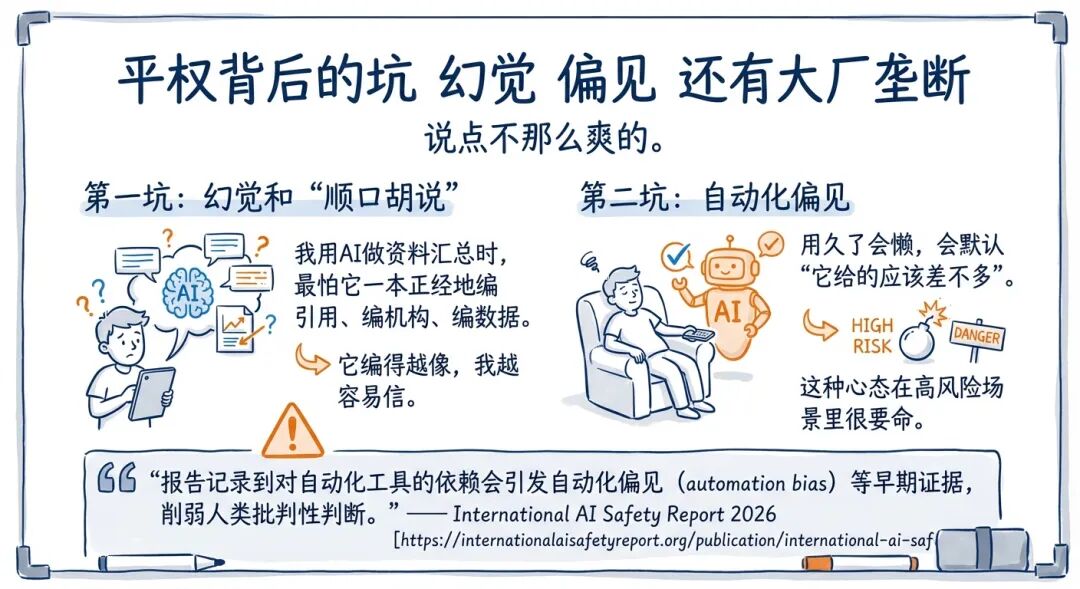
Let's talk about something less fun.
First pit: hallucinations and "smooth-talking nonsense." When I use AI to compile materials, what I fear most is it seriously making up citations, institutions, data. The more real it fabricates, the more I'm likely to believe it.
Second pit: automation bias. Use it long enough you get lazy, you default to "what it gives should be about right." This mentality is deadly in high-risk scenarios.
"Reports document early evidence that reliance on automated tools can induce automation bias, undermining human critical judgment." — International AI Safety Report 2026 [https://internationalaisafetyreport.org/publication/international-ai-safety-report-2026]
Third pit is more realistic: so-called "democratization," might just be "entry leveled," but power might not be leveled. Foundation models, compute, data, distribution channels—a lot are still concentrated in a few companies' hands. You use it very happily, but you're also being led by its rules: what it can answer, can't answer; what it defaults to recommending; what content it ranks first.
If one day APIs raise prices, policies change, models tighten, your "democratization" might get cut off.
"Some experts are skeptical of the 'AI democratization' narrative in 2026, believing power will further concentrate in a few companies, and stronger independent oversight is needed." — Tech Policy Press (expert predictions on 2026 policy risks) [https://techpolicy.press/expert-predictions-on-whats-at-stake-in-ai-policy-in-2026]
There's also a long-term risk: trust gets eroded. Deepfakes, batch content washing, AI-generated comments steering narratives... when you increasingly can't tell "is this real?", people become more extreme: either believe everything, or believe nothing.
If knowledge democratization ends up becoming "whoever fakes better gets more traffic," that's pretty ironic.
"Concerns about AI-generated content (like deepfakes) potentially eroding social trust are repeatedly mentioned in 2026-related discussions, affecting journalism, justice, and public life." — UC Berkeley AI expert focus compilation [https://vcresearch.berkeley.edu/news/11-things-uc-berkeley-ai-experts-are-watching-2026]
So my current conclusion is pretty awkward: AI is indeed "democratizing," but it's also creating new inequalities—like the gap between "people who can ask questions" and "people who only copy-paste"; like the gap between "people who can verify" and "people who only look at conclusions"; and like the gap between "people who control underlying resources" and "people who can only use APIs."
06 How I Use AI Now: Three Dirt-Simple Rules
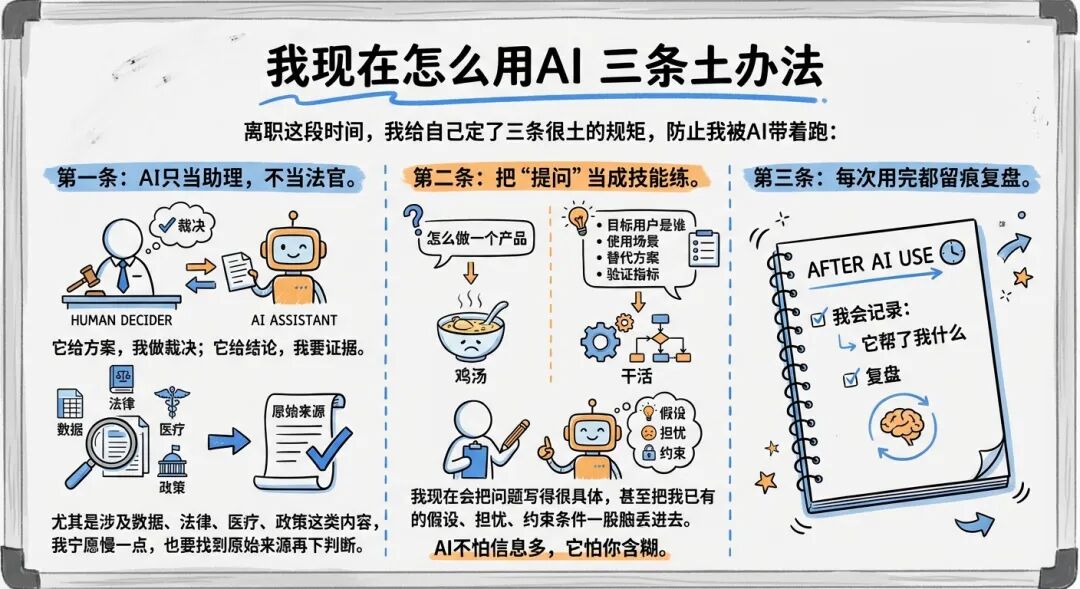
During this period after quitting, I set three very dirt-simple rules for myself, to prevent AI from leading me by the nose:
Rule One: AI is only an assistant, not a judge.
It gives solutions, I make decisions; it gives conclusions, I want evidence. Especially with content involving data, law, medicine, policy—I'd rather be slow, but find the original source before making judgments.
Rule Two: Treat "asking questions" as a skill to practice.
Same question, you ask "how to make a product," it gives you chicken soup; you ask "who's the target user, usage scenario, alternative solutions, validation metrics," then it starts working.
Now I write questions very specifically, even dump all my existing assumptions, concerns, constraints into it. AI doesn't fear too much info, it fears you being vague.
Rule Three: Leave a trail and review after each use.
I record: what it helped me with, where it talked nonsense, how I verified, how I changed it in the end. This habit is annoying at first, but it turns "satisfaction" into "ability." Otherwise you use AI for a year, you might just be more skilled at depending on it.
By the way, here's a pretty face-slapping stat: many people think AI will improve public service experience, but reality isn't that fast.
"Only 4% of respondents believe AI has significantly improved their experience accessing public/government services." — Harvard Kennedy School (Growth Policy Project related research discussion) [https://www.hks.harvard.edu/centers/mrcbg/programs/growthpolicy/ai-needs-clinical-trials-harvards-findings-democratization]
This also reminds me: AI is fierce at the personal level, not so magic at the system level. Don't rush to deify it, it's still on the landing path.
After quitting, my biggest change in view about AI went from "the tool is strong" to "barriers really are loosening." Learning no longer requires a master, building products no longer requires a team, information no longer requires mixing in circles to touch.
But barriers loosening doesn't mean the world is fair. The time you save, you have to spend on harder things: judging, verifying, making tradeoffs, bearing consequences.
I'm pretty curious: what's the most satisfying time you've used AI recently? Also feel free to share pits you've stepped in. See you in the comments, I want to copy some real cases as teaching materials.
Source List
https://www.research-and-innovation.cornell.edu/generative-ai-in-academic-research/
https://internationalaisafetyreport.org/publication/international-ai-safety-report-2026
https://techpolicy.press/expert-predictions-on-whats-at-stake-in-ai-policy-in-2026
https://vcresearch.berkeley.edu/news/11-things-uc-berkeley-ai-experts-are-watching-2026