
Seeing this title, you're probably about to close the tab—more chicken soup.
But this isn't that. This is my most authentic experience from nearly two and a half months since leaving my job, attempting to build a one-person company. No filters, no packaging, and none of that "I quit my job and now make millions a year" fantasy narrative. Just an ordinary person's real record of fumbling around in the dark.
Let Me Pour Cold Water on This First
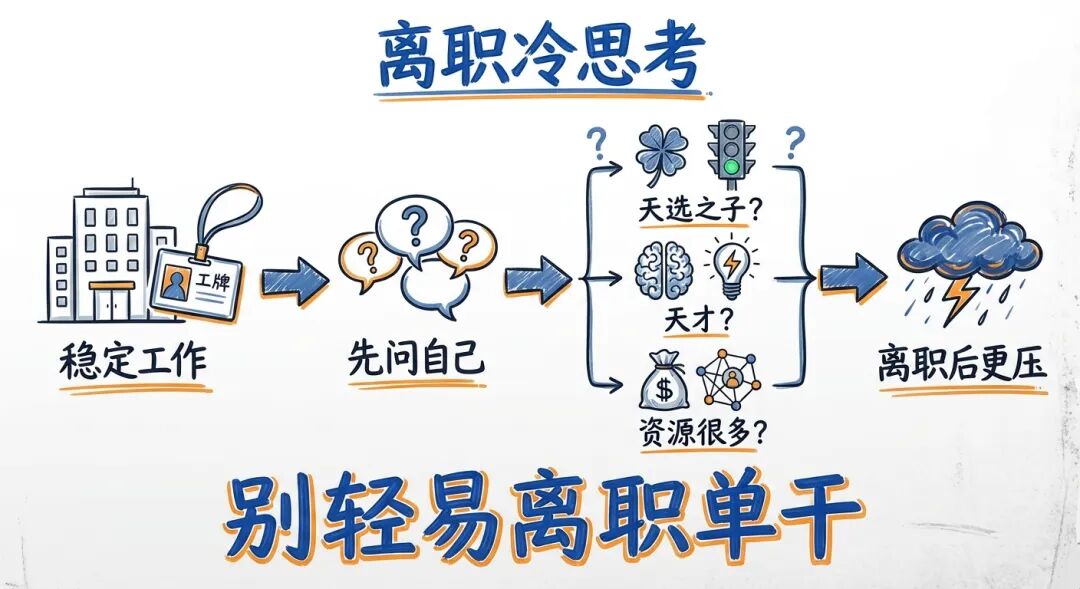
If you currently have a reasonably stable job, I sincerely advise you: Don't quit lightly.
A colleague who sat one cubicle over at my previous company talked to me many times, advising me not to quit, painting it in the worst colors. Other colleagues also tried to dissuade me, but back then I never listened. So why am I now turning around to advise you? Because I think you need to first solve these three questions:
Be Clear About Who You Are
Ask yourself three questions honestly—
First, are you one of those chosen ones? Does everything go smoothly for you, are you so lucky it's ridiculous, like the whole world is giving you a green light? If so, you can consider it.
Second, are you a genius? Do you grasp everything instantly, draw analogies effortlessly, and accurately predict every trend? If so, you can give it a try.
Third, are you holding abundant resources? Like the protagonist in "Hello Mr. Billionaire," tasked with spending a hundred million in a month—do whatever you want. If so, go for it.
Think about it—are you?
Well, I'm not.
When I initially quit, it wasn't on a whim, and it wasn't because I read a few anxiety-inducing articles about "you must start a business by 35." I really couldn't handle it physically or mentally anymore—the project pressure at that time was like a mountain, crushing me until I couldn't breathe. I just thought, leave, I must leave, determined to go.
But what I never expected was: The mental pressure after quitting was even greater than when I was working.
Running a one-person company is far less romantic than imagined. Just after quitting, some people might take three weeks to realize it—but damn, I started the very next day. That month, every day at 5 o'clock, 5:30, sometimes even 4 o'clock I'd wake up. The later I slept at night, the earlier I'd get up. Result? A check-up at Xuanwu Traditional Chinese Medicine Hospital—mild depression 😞.
But to be fair: The AI era has indeed "democratized" many abilities—things one person couldn't do before can now be done with various tools. But what came with it was something I completely didn't anticipate:
Mental defeat—Learning something new every day, feeling like I know nothing every day. A concept I just figured out yesterday, today brings a new framework, new tool, new paradigm. You can never catch up, and you know you can't catch up.
Execution chaos—Too many ideas. Want to build AI products, want to do content distribution, want to build communities too. One idea today, another direction tomorrow. Want to grab everything, can't hold onto anything. Priorities are never clear, busy until late night every day but looking back, nothing's finished.
And the most suffocating—powerlessness. You work so hard to create something, but will anyone use it? Will anyone be willing to pay for it? This question is like a black hole. The more you think about it, the more afraid you get. The more afraid, the less you dare to move forward.
None of these feelings—I never thought about any of them before quitting.
Two months have passed.
Subscription fees burned plus various miscellaneous expenses, I calculated after paying off my credit card today—exactly thirty thousand. Average of ten thousand per month. Just watching the bank account balance shrink bit by bit, doing mental gymnastics every day—"It's okay, this is an investment, not consumption." But honestly, that anxiety from watching assets shrink, that bitterness from having no income—you can't fool yourself.
I believe these feelings are inescapable for everyone who wants to build a one-person company, wants to start a business, has grand ambitions.
So, how should the path go? How should it be taken? What's the next step? How to persist?
Even now I don't dare say I'm "starting a business." Because real entrepreneurs—the maturity of their mindset, their stability when facing uncertainty—only they themselves know. I'm still far behind.
But, Since I've Chosen, and When I Believe "Everything Is the Best Arrangement," You Suddenly Realize, Worst Case I'll Just Find Another Job. Getting Your Mindset Right Is Always First!
So, also in this darkness where "nothing is certain," I later figured something out.
More accurately, I was awakened by one sentence.
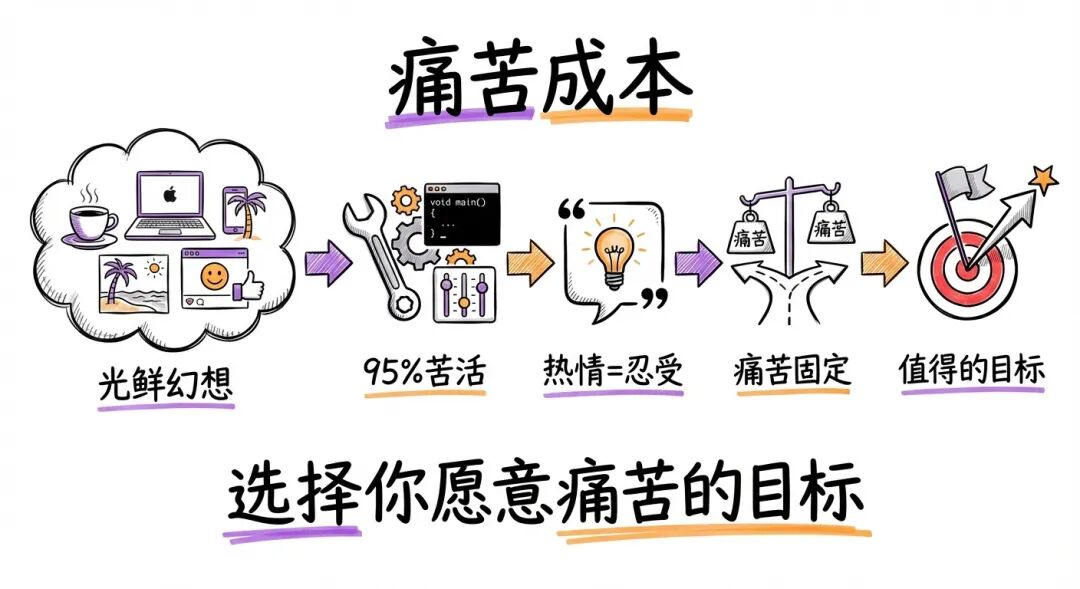
"The Latin root of the word Passion means 'to suffer' and 'to endure.' So following your passion was never about 'doing what you love,' but rather 'finding that goal you're willing to suffer for.' Truly successful people spend 95% of their time doing things they don't enjoy."
— Alex Hormozi, "Why 'Follow Your Passion' Is Terrible Advice" Video Link
When I saw this passage, I was stunned for a long time.
Not that dramatic "enlightenment" epiphany, but a very quiet touch. Like someone clearly articulated in one sentence what you vaguely felt but couldn't express.
Because I always thought running a one-person company should be passionate, full of energy every day, like those YouTube bloggers show—a cup of coffee, a MacBook, facing the ocean, financial freedom just around the corner. The "digital nomads" and "free entrepreneurs" you see on social media—which one isn't smiling and living glamorously?
But what's the reality?
Of the things I do every day, probably less than 5% make me feel "interesting." The remaining 95% is: repeatedly debugging AI Agent configuration parameters, staring blankly at a bunch of data in the database, a script I spent three days writing produces all garbage results, at 2 AM still troubleshooting some inexplicable bug, staring at a blank WeChat public account backend not knowing what to write...
These things aren't romantic at all, not cool at all.
But after understanding that sentence, I actually felt relieved.
Because pain isn't accidental—pain is a cost. And it's a fixed cost.
You suffer at work, you suffer as an entrepreneur too. The difference isn't "which path has no suffering," but—what are you willing to suffer for.
The First Light: Choose a Direction You're Willing to Suffer For
After understanding that "pain is a fixed cost," I began to re-examine those entrepreneurs' stories.
Previously when looking at others' success, I saw the results: how much funding raised, how fast user growth, annual revenue. But now I focus more on that middle process no one wants to talk about.
I later watched a compilation of founder interviews featuring 7 founders who reached considerable scale. Their commonality boils down to two things:
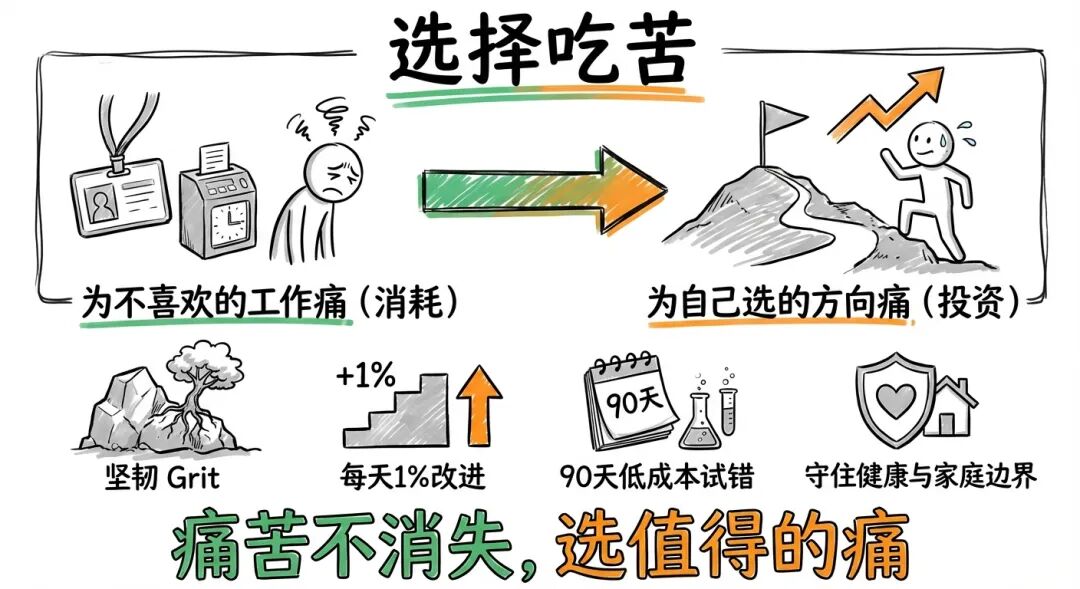
"Grit plus 1% daily improvement equals compound interest. Use 90-day cycles for low-cost trial and error, calmly accepting a 30% failure rate. Meanwhile, guard the boundaries of family and health for long-term sustainability."
— Silicon Valley Girl, "I Interviewed 7 Founders: How They Built $10 Billion Companies" Video Link
Two keywords: Grit and 1% Daily.
Not some grand narrative of "I'm going to change the world." Not that ambition of "making millions annually within three years." But a very plain, very dumb, even somewhat boring methodology—just be a little better today than yesterday. That simple.
This is completely different from my previous mindset. I always felt that if I didn't make some "major breakthrough" today, the day was wasted. Burned ten thousand yuan, must see ten thousand yuan in returns. But reality is, in the early stages of entrepreneurship, most of the time you're doing "useless work"—or more accurately, those things you thought were useless work at the time were actually paving the way for later. You just can't see it yet.
Another passage also deeply touched me:
"There's no ready-made path waiting for you. The only method is to first enter the scene and start from the bottom. This process is inevitably accompanied by continuous pain and failure, and what you need is a clear awareness of these costs."
— Lex Clips, "Advice for Young People: Dive Headfirst into Adventure" Video Link
"First enter the scene"—I chewed on these five words for a long time.
Because before quitting, I spent enormous amounts of time "thinking"—thinking about direction, thinking about business models, thinking about tech stacks, thinking about competitive analysis. Thinking and thinking, the more I thought the more anxious, the more anxious the less I dared to act.
But what really taught me things were all those things I "did" after quitting. Even if done poorly, even if the direction might be wrong.
Like this AI product discovery system I built—it might not have brought me a single penny yet. But in this process, I learned how to use AI Agents for parallel data collection, how to build data pipelines, how to make AI automatically score and analyze user pain points, how to turn a bunch of scattered information into actionable judgment. More importantly, I began to understand what a "product" really is—not something you think is cool, but something people actually need.
These insights and capabilities—I couldn't have thought them up sitting in an office for a hundred years. They can only grow during the "doing" process.
So my current understanding is: Pain won't disappear, but you can choose what to suffer for. Suffering for a job you don't like versus suffering for a direction you chose yourself—same suffering, but completely different value. The former is consumption, the latter is investment.
The Second Light: Stop Thinking, Just Try
After understanding that "pain is a fixed cost," the second question immediately followed: What exactly should I do?
This question trapped me for a long time. Seeing the AI track hot, wanted to make AI products; seeing short videos popular, wanted to make content; seeing someone making tens of thousands monthly with SaaS, also wanted to make SaaS; seeing someone making money with communities, heart itched again. One idea today, another direction tomorrow, each seemed promising, but couldn't stick with any.
You know this feeling? Like standing at a crossroads, every direction seemingly leading to the destination, but you just don't dare take the first step—because you're afraid of choosing wrong.
Until I saw this passage:
"Interest isn't figured out by sitting there thinking, but gradually experienced through trying and comparing. Small-scale trial and error is far more important than chasing trends."
— Dan Martell, "How to Figure Out What to Do With Your Life" Video Link
And another passage:
"Most people are stuck in 'decision purgatory' unable to move because they overestimate the cost of failure and underestimate the upside of uncertainty. What you need to do is lower the weight of others' evaluations and embrace uncertainty."
— Alex Hormozi, "How to Change Your Life" Video Link
"Decision purgatory"—these four words were literally describing me.
I did indeed overestimate the cost of failure. I always felt that if a direction had no results after a month, then that month was "lost," that ten thousand yuan burned in vain. But actually? A month of trial and error earned a definite signal: this path doesn't work.
That itself is enormous value. Because you eliminated a wrong option, your next choice will definitely be more precise. The essence of entrepreneurship isn't "getting it right once," but "quickly eliminating wrong options." Each failure narrows your search range.
So my strategy changed.
90-day project cycles, low-cost investment, rapid validation. Validation succeeds, fully invest and double down. Validation fails, calmly accept, quickly switch to the next direction. I no longer pursue "getting it right once," but pursue "knowing whether this path is right as quickly as possible."
This sounds simple, common sense. But for me it was a huge mindset shift.
Because education from childhood has always told you: be cautious, be thorough, be fully prepared before acting. Prepare three years for the college entrance exam, polish your resume repeatedly, do a complete feasibility analysis before starting a project.
But running a one-person company is exactly the opposite—you can never be ready. You can only become ready in the process of doing.
This is also the "learning by doing" I wrote about in my previous reflection—it's not just a learning method, but a survival strategy. In this era where everything is accelerating, by the time you're "ready," the window has long closed.
The Third Light: AI Is Not Egalitarian, It's an Amplifier
After discussing mindset and methodology, let me finally talk about my understanding of "one-person company" itself.
Over the past two years, the whole world has been shouting "everyone can start a business in the AI era," "rise of one-person companies," "AI replaces teams." When I first quit, I believed it too, thinking with AI I could do the work of ten people alone, the entrepreneurship barrier pulled to an unprecedented low.
Two and a half months later, I want to say: This statement is only half right.
AI indeed lowered the barrier to "doing things." Previously building a website required frontend and backend engineers plus designers working a month, now with Cursor + Claude you might build a working product in three days. This is true.
But the problem is—everyone's barrier has lowered. When everyone can use AI to write code, everyone can use AI to generate content, "knowing how to use AI" itself is no longer competitive.
So what is?
"AI won't average out the gap between people, it will only amplify it. Generalists with Direction can leverage AI for rapid learning and trial-and-error, gaining true competitive advantage through the 'research → experiment → refine → self-build → teach' closed loop."
— Dan Koe, "You Need to Become a High Agency Individual" Video Link
This passage is very important—I copied it into my notebook.
AI is an amplifier, not an equalizer. If you know which direction to go, AI can help you go faster and farther. But if you have no direction yourself, AI will only help you spin in place more efficiently.
I increasingly feel that the core of a one-person company isn't "one person using AI to replace a team," but "a person with a sense of direction leveraging AI to amplify their judgment a hundredfold."
Tools change. Today it's ChatGPT, tomorrow might be something else. Models update, frameworks iterate, APIs deprecate. But your deep understanding of a field, the intuition you accumulate in practice, those pits you stepped in—these won't become obsolete.
Another point that particularly impressed me was about the future direction of one-person companies:
"In the next phase, one-person companies should shift from 'selling information' to 'selling learning experiences'—using AI chatbots to provide interactive, personalized learning experiences. The era of just selling courses, PDFs, and static content is ending."
— Dan Koe, "If I Started a One Person Business in 2026 from Scratch" Video Link
This made me re-examine my path over the past two months. I've been doing content—WeChat public account articles, Xiaohongshu notes, video scripts. But pure information distribution is increasingly like a red ocean in the AI era. ChatGPT itself can summarize information on any topic for you—why should people come see your content?
What's truly valuable isn't the information itself, but the process of helping others turn information into capability.
This insight might become the direction for my next 90 days. What exactly to do isn't certain yet—maybe an AI-assisted learning product, maybe an interactive tool helping specific groups solve specific problems. But at least, compared to two months ago when I had no direction and couldn't sleep from anxiety every night, the current me has a slight sense of outline.
That's enough. Direction doesn't need to be clear from the start; it gradually emerges through action.
A Practical Small Method
Writing to here, let me add a specific method I've been practicing recently, for those who like me often get trapped in valleys.
Some days are really hard to endure. Don't want to get up in the morning, sit at the computer not wanting to do anything, brain full of "what's the meaning of all this" voices. Anxiety and nihilism alternate, you know you should work, but just have no energy at all.
My previous approach was: first adjust mindset—meditate, deep breathing, watch motivational videos—wait until "ready" then start.
But this doesn't work at all. Because you're never "ready."
Later I saw a passage:
"Energy can be reverse-engineered by behavior. First 'pretend' to be in a high-energy state—sit up straight, speak faster, move decisively—this pretended state, through emotional contagion, will actually make you more energetic."
— Ali Abdaal, "How to Show Up With Energy When You're Exhausted" Video Link
In plain terms: First move, feelings will follow.
I tried it. Really works.
When you don't want to work, don't try to "adjust your mindset" before starting. Directly open the computer, do one simplest thing—update a line of code, reply to a message, write a paragraph of notes. No quality requirements needed, just "move."
Once started, inertia pushes you forward. Ten minutes later you'll find you're already working, and the state is decent.
This isn't some profound truth, but for those who like me often get trapped by anxiety and nihilism, maybe it really helps.
Light in the Darkness
Finally, back to this article's theme: Finding hope in darkness.
I don't want to write an inspiring passage at the end, telling you "as long as you persist you'll definitely succeed." That's a lie. Persisting doesn't necessarily lead to success; many people persisted for ten years and still didn't make it.
I also don't want to say "everything will get better." Because I don't know myself if it will get better.
But there are a few things that, in these two and a half months of darkness, I truly figured out:
First, darkness won't disappear. No matter what level you reach, anxiety, confusion, self-doubt—these things will always be there. They don't exist because you're not strong enough; they're just part of this thing. Or rather, they're the fixed cost of anything worth doing.
Second, you don't need to see light to walk. Most of the time, you're just fumbling in the dark. No one can give you certainty, no one can tell you this path is definitely right. What you need to do isn't wait for light to appear, but get used to walking in darkness.
Third, labels don't matter. I said at the beginning, even now I don't dare call myself an "entrepreneur." Then don't call it that. What does it matter what it's called—entrepreneurship, freelancing, tinkering, struggling, messing around—all fine. What it's called doesn't affect what you need to do every day. Those who label themselves "entrepreneurs" may not go further than you; those who never call themselves anything may not fail to emerge.
Tomorrow morning when I wake up, I'll still open my computer, still continue doing what I'm doing. Not because I'm certain it will succeed, and not because I think I'm so great.
But because I chose this path. I'm willing to suffer for it.
And this, perhaps, is the true meaning of "passion."
"The etymology of passion is to suffer."
If you're also in the dark, then keep walking. Don't need to see light—as you walk, you yourself will become light.
Or maybe you won't.
At least you're walking.
Finally, to friends who read this far: The biggest feeling is loneliness. Alone, you never know if what you're thinking is correct. Catching a colleague, classmate, or friend, you want to chat for ages—not being chatty, just pent up. Walking this path for two months, feeling it's difficult—maybe that's a bit unmanly, but honestly, when you truly meet someone who's started a business, you realize how hard they have it. With this insight, paying respect to those formally starting businesses... I don't know how long I can persist, but at least I don't want to waste this opportunity ♥️. Because believing is seeing... ✨
Video Sources
Alex Hormozi, "Why 'Follow Your Passion' Is Terrible Advice" - Watch Video
Silicon Valley Girl, "I Interviewed 7 Founders: How They Built $10 Billion Companies—Their Common Answers Were These" - Watch Video
Lex Clips, "Advice for Young People: Dive Headfirst into Adventure | Paul Rosolie and Lex Fridman" - Watch Video
Dan Koe, "You Need to Become a High Agency Individual... Here's How" - Watch Video
Dan Martell, "How to Figure Out What to Do With Your Life" - Watch Video
Dan Koe, "If I Started a One Person Business in 2026 from Scratch, Here's How I'd Do It" - Watch Video
Alex Hormozi, "How to Change Your Life" - Watch Video
Ali Abdaal, "How to Show Up With Energy When You're Exhausted" - Watch Video