Resignation Series -- Learn By Doing & Demystifying AI -- <2/3>
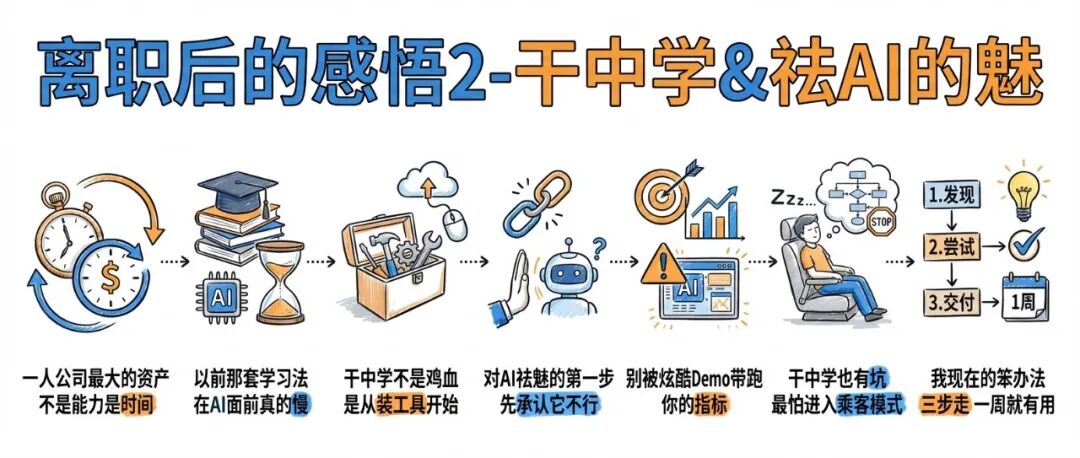
In a previous article, I mentioned how I didn't truly realize AI was dismantling the barriers to "entrepreneurship" piece by piece until after I quit my job. That was my first insight after quitting. Today I'm sharing my second: AI is transforming our ingrained thinking about learning a discipline, a technology...
So through this piece, I want to emphasize two things: "learning by doing," and demystifying AI. These are my most striking realizations while experimenting with the "solo company" paradigm!
01 A Solo Company's Greatest Asset Isn't Capability—It's Time
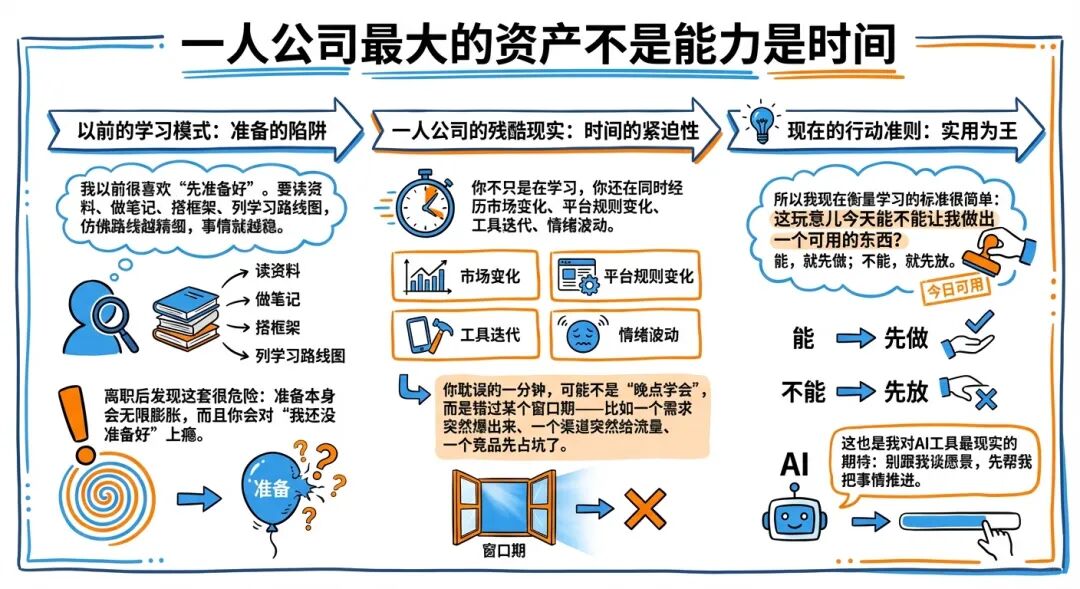
I used to love "getting fully prepared first." Reading materials, taking notes, building frameworks, mapping out learning roadmaps—as if the more detailed the route, the more secure the outcome. After quitting, I discovered this approach is dangerous: preparation itself expands infinitely, and you become addicted to "I'm not ready yet."
The harshest reality of a solo company is: you're not just learning—you're simultaneously experiencing market shifts, platform rule changes, tool iterations, emotional fluctuations. Every minute you delay might not mean "learning it later," but missing a window—like a sudden demand surge, a channel suddenly pushing traffic, a competitor claiming territory first.
So my current standard for evaluating learning is simple: Can this thing help me make something usable today? If yes, do it first; if not, shelve it.
This is also my most pragmatic expectation of AI tools: don't talk to me about vision—help me move things forward first. Frankly, I need a lever for action.
"84% of people use AI primarily to improve speed." — Synthesia's AI in Learning & Development Report 2026
https://www.synthesia.io/reports/ai-in-learning-and-development-report-2026
Speed, in the context of a solo company, isn't about "feeling good"—it's about survival.
02 The Old Learning Methods Are Genuinely Slow in the Age of AI
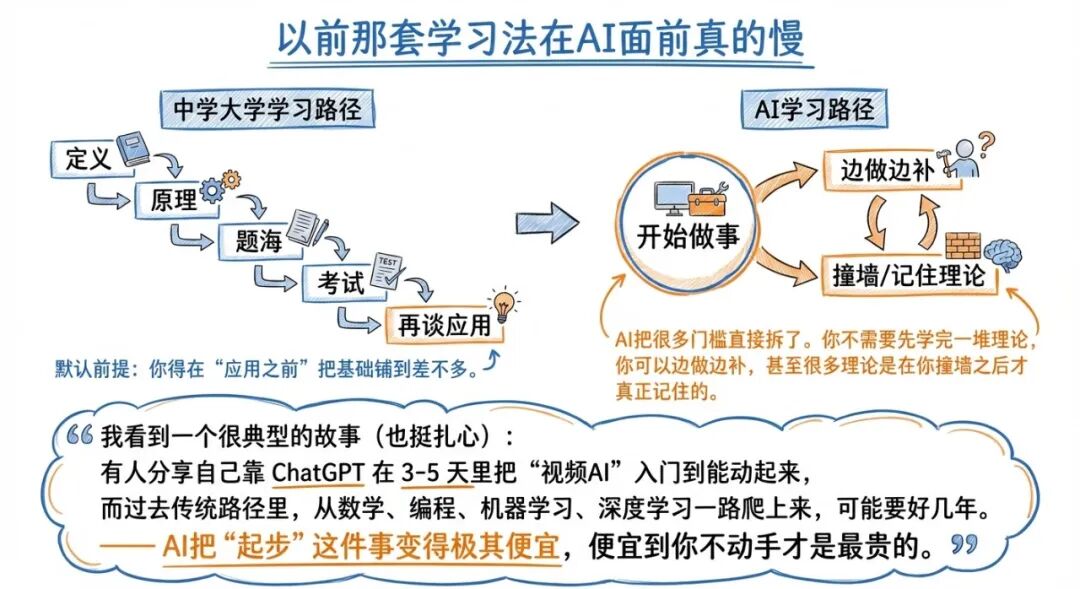
I'm too familiar with the learning path from middle school and university: definition—principles—practice problems—exams—then application. It's not useless, but it assumes a premise: you need to lay a solid foundation before applying anything.
But now AI has torn down many barriers directly. You don't need to master all the theory before you start doing things—you can build while filling gaps, and often you only truly internalize theory after you hit a wall.
I came across a very typical (and somewhat sobering) story: someone shared how they went from beginner to functional in "video AI" in 3-5 days using ChatGPT, whereas the traditional path—math, programming, machine learning, deep learning—could take years. You can question whether that's exaggerated, but I agree with the direction: AI has made "getting started" extremely cheap—so cheap that not taking action is what costs the most.
"AI learning is shifting from content accumulation toward short, dense, workflow-adjacent training that emphasizes judgment and real decision-making." — eLearningIndustry
https://elearningindustry.com/envisioning-2026-where-ai-learns-fast-and-humans-learn-wise
My own experience is more blunt: in the past I'd spend a week "understanding a concept"; now I spend an hour making a half-finished prototype, get stuck, then look up just that one piece of the concept—and I learn it more solidly. Because I have a pain point, context, and a problem I need to solve right now.
Just like in the article I published earlier: the story of a Swedish high school dropout who eventually made it to OpenAI: "Learn By Doing" Exemplified—From High School Dropout to OpenAI Researcher: Gabriel Petersson Interview (Extraordinary).
Surely some will say this is just an outlier, but abilities and energy compound—success doesn't only come from maxing out one attribute. I'm just using this to illustrate the method.
03 Learning By Doing Isn't Motivational Hype—It's Grunt Work Starting With Installing Tools
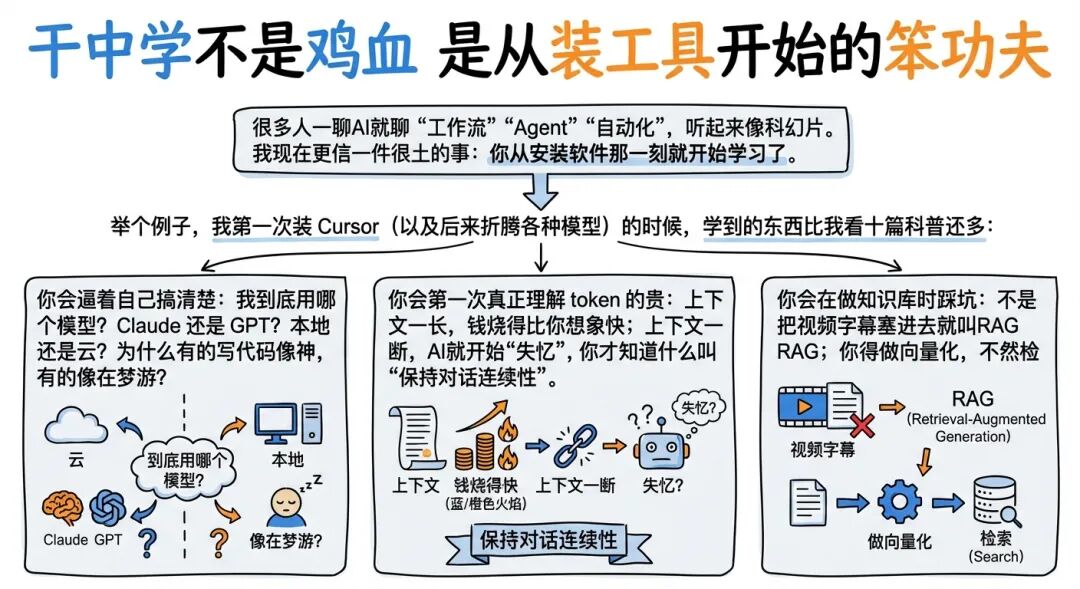
Many people talk about AI in terms of "workflows," "Agents," "automation"—sounds like sci-fi. I now believe in something much more mundane: you start learning the moment you install the software.
For example, when I first installed Cursor (and later tinkered with various models), I learned more than from reading ten explainer articles:
You're forced to figure out: which model do I actually use? Claude or GPT? Local or cloud? Why does one write code like a genius and another like it's sleepwalking?
You experience firsthand how expensive tokens are: long context burns money faster than you'd expect; broken context makes the AI "forget," and only then do you understand what "maintaining conversation continuity" means.
You'll hit snags building a knowledge base: it's not RAG just because you shove video transcripts in; you need vectorization, or else retrieval is "keyword mysticism" and semantics won't match at all.
Sure, you can learn these things in courses too, but honestly, many courses drag you through a pile of jargon to appear systematic. When you're actually hands-on, you only care about one thing: I'm stuck right now—what's the next step?
"By 2026, AI tools will be more deeply embedded in learning and workflows, with learning paths leaning toward projects and practice." — TutorFlow
https://tutorflow.io/blog/how-ai-is-transforming-education-2026
My rule for myself now is: every time I learn something new, it must land on a "deliverable." Even if it's tiny, like:
Write a script that runs;
Build a functional Notion/Obsidian knowledge base with search;
Create a usable content template;
Make a small automation tool I can share with friends.
Don't aim for perfection—aim for "it runs." Once it runs, you'll naturally want to optimize, and optimization is the second stage of learning.
04 The First Step in Demystifying AI: Admit It Doesn't Understand You
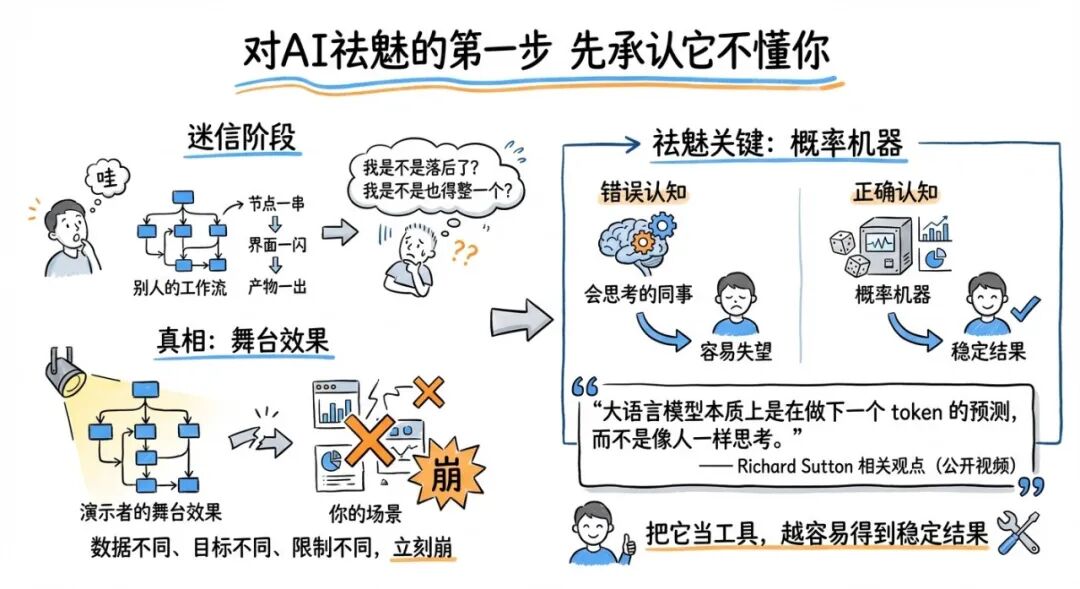
When I first started using LLMs, I was starstruck too: watching someone demo a workflow—nodes strung together, interface flashing, output appearing—I'd think "wow." Then I'd immediately feel anxious: am I falling behind? Should I build one too?
Later I discovered many flashy demos share a common trait: it's a "stage performance" the presenter tuned for their specific scenario. When you try it, different data, different goals, different constraints—it might instantly collapse.
What helped me most in demystifying was treating AI as a "probability machine," not a "thinking colleague." The more you anthropomorphize it, the more disappointed you'll be; the more you treat it as a tool, the more stable your results.
"Large language models are fundamentally doing next-token prediction, not thinking like humans." — Richard Sutton's related views (public videos/interviews)
https://www.youtube.com/watch?v=LEintLO7ML4
That sounds cold but is incredibly liberating. Because it directly explains two phenomena:
Sometimes it confidently spews nonsense—not because it's "rebellious," but because it's completing the most likely answer;
What you need isn't for it to "understand you," but for you to give it clear enough constraints so it "outputs in the format you want."
So when I write prompts now, I rarely chase fancy tricks—instead I pursue three things:
Clear objective (what do you ultimately want me to deliver)
Clear boundaries (what can't/shouldn't be done/fabricated)
Clear evaluation criteria (what counts as good/what's unacceptable)
Treat AI like outsourcing—write a clear contract, and it becomes much more useful.
05 Don't Get Distracted By Flashy Demos—Your Only Metric Is "Is It Worth It"
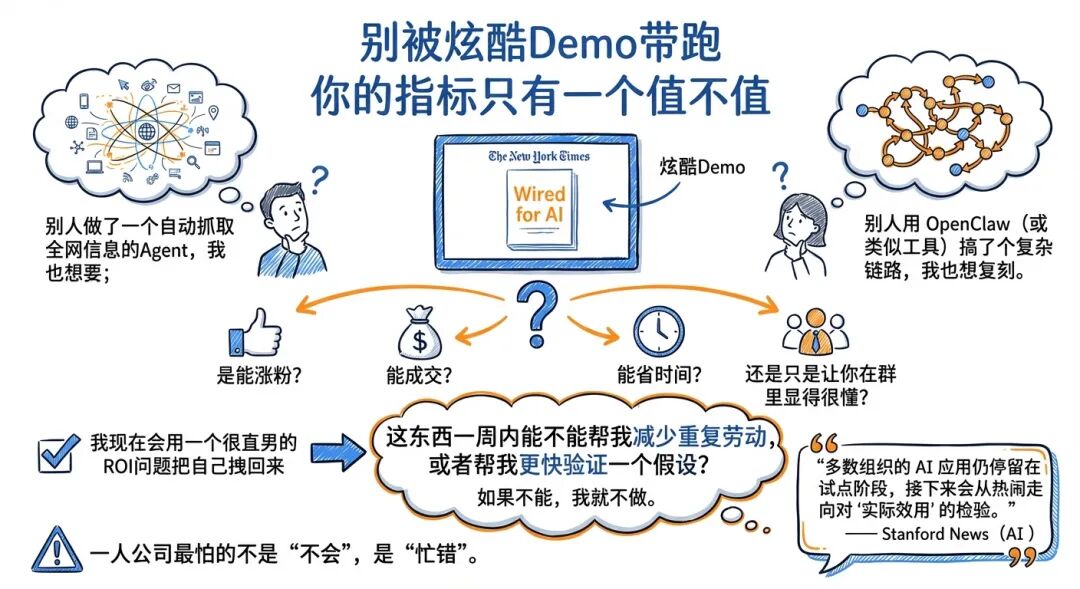
I've seen too many people (myself included) stumble over "comparison syndrome": someone built an Agent that auto-scrapes info from across the web—I want one too; someone used OpenClaw (or similar) to build a complex chain—I want to replicate it.
The question is: once you replicate it, what does it bring? Does it grow your audience? Drive conversions? Save time? Or does it just make you look knowledgeable in group chats?
I now pull myself back with a very pragmatic ROI question: Can this thing help me reduce repetitive work or validate a hypothesis faster within a week? If not, I don't do it.
Because the biggest fear for a solo company isn't "not knowing how"—it's "busywork on the wrong things."
"Most organizations' AI applications remain stuck in pilot phases; next they'll move from hype toward testing 'actual utility.'" — Stanford News (AI experts predict 2026)
https://news.stanford.edu/stories/2025/12/stanford-ai-experts-predict-what-will-happen-in-2026
Those four words—"actual utility"—should be taped to the edge of my monitor. Every node you build, every automation, every model swap should answer: does it make results better? Faster? More stable? Cheaper? If none of those, you're just adding drama for yourself.
06 Learning By Doing Has Pitfalls—The Worst Is Entering Passenger Mode
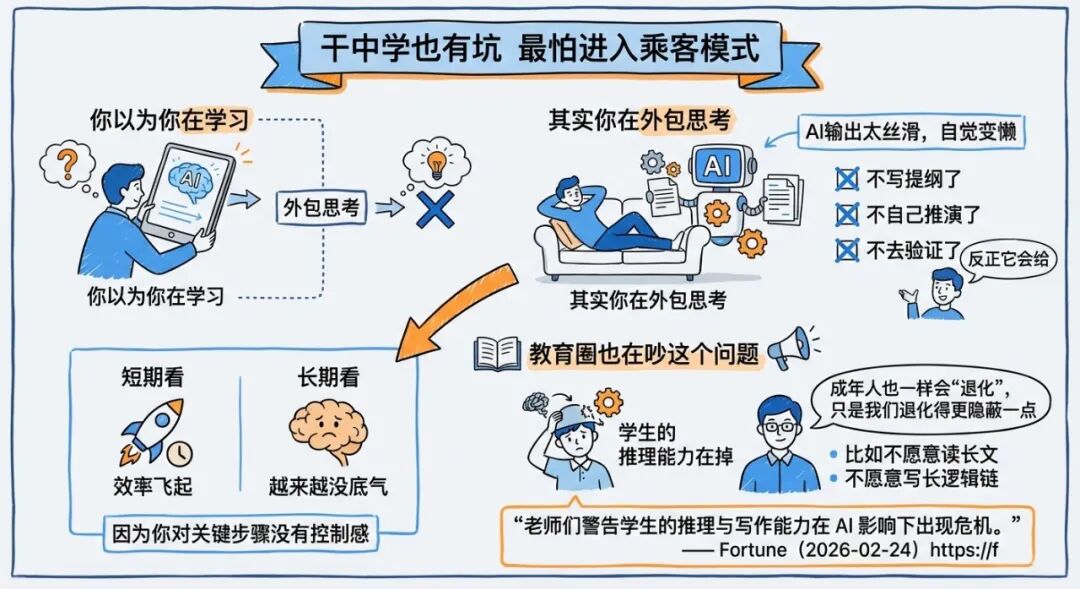
I should pour some cold water too: learning by doing isn't invincible. It's easy to fall into another trap—you think you're learning, but you're actually outsourcing your thinking.
Especially when AI output is too smooth, you unconsciously get lazy: no more outlining, no personal reasoning, no verification—"it'll give it to me anyway." Short-term, efficiency skyrockets; long-term, you'll feel less and less confident, because you have no control over the critical steps.
The education world is fighting over this lately, saying students' reasoning abilities are declining. Though I'm not a student, I empathize: adults "degrade" the same way—just more covertly, like not wanting to read long articles or write long logical chains.
"Teachers warn that students' reasoning and writing abilities are in crisis under AI's influence." — Fortune (2026-02-24)
https://fortune.com/2026/02/24/students-cant-reason-teachers-warn-ai-fueling-crisis-in-kids-ability-to-think/
There's also a very real counterintuitive fact: AI doesn't necessarily reduce workload—it might actually make you busier. Because you have to monitor it, revise it, align it, feed it context, handle its hallucinations.
"AI doesn't necessarily reduce work; in many cases it intensifies it, because people need to spend more time managing and correcting AI output." — Harvard Business Review (2026-02)
https://hbr.org/2026/02/ai-doesnt-reduce-work-it-intensifies-it
So my approach is: treat AI like a "junior assistant," but I make the key judgments. For instance:
I set the topic direction, AI only helps me brainstorm angles;
I build the structure, AI only helps me fill in cases and polish wording;
I own the conclusion—I always double-check AI's conclusions.
I even deliberately keep some "manual steps" to force myself not to become a passenger. Bluntly put, I don't want to become someone who only knows how to push buttons.
07 My Current Grunt Method: Three Steps, Results in a Week
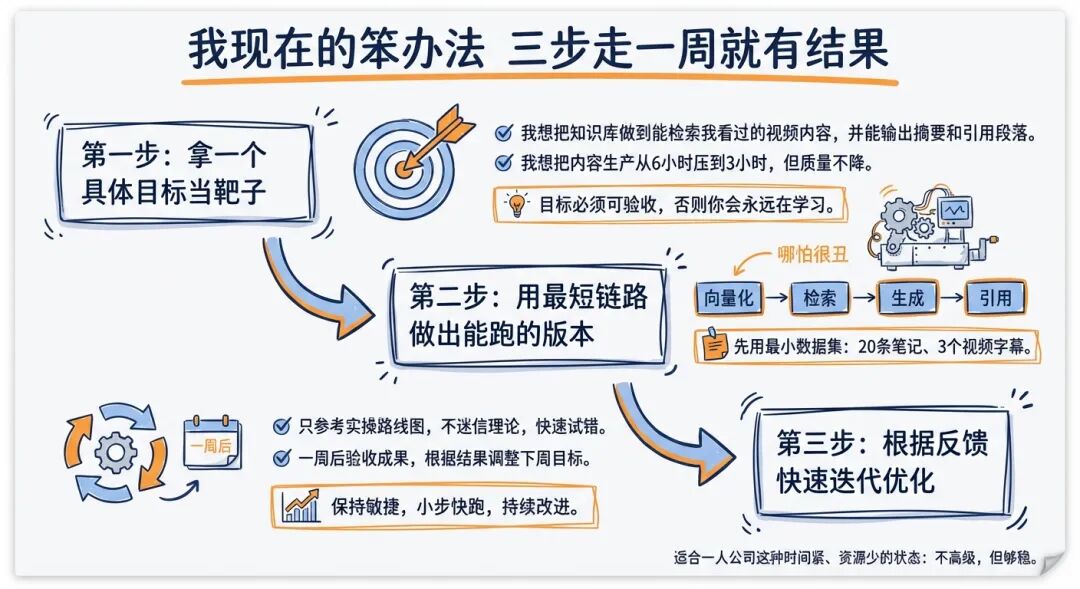
Finally, here's a small "learn by doing" workflow I'm currently using—not fancy, but stable enough, suitable for a solo company with tight time and limited resources:
Step 1: Take a specific goal as your target
Don't start with "learning AI" or "researching Agents." I usually phrase it as one sentence:
"I want to build a knowledge base that can search the content of videos I've watched and output summaries with cited segments."
"I want to compress content production from 6 hours to 3 hours without lowering quality."
Goals must be verifiable, or you'll be learning forever.
Step 2: Make a working version using the shortest chain
Even if it's ugly. For a knowledge base, start with the smallest dataset: 20 notes, 3 video transcripts. First get "vectorization—retrieval—generation—citation" working, then iterate.
For reference paths, I look at hands-on roadmaps but only take the parts I can use right now.
"A viable path for learning AI should be project-driven, first mastering practical aspects like data and deployment, then gradually filling in theory." — EkasCloud (2026 AI Learning Roadmap)
https://www.ekascloud.com/our-blog/how-to-start-learning-ai-in-2026-a-stepbystep-roadmap-for-students/3606
Step 3: Debrief on two things
Which step wasted the most time? Can it be automated/templated next time?
Which step is a "human skill" I must master? (Like judgment, trade-offs, aesthetics, communication)
I won't chase "mastering AI." I care more about: can I use it to get things done faster while not handing over my brain?
Closing: Learning By Doing and Demystifying—The Two Best Tuition Fees Since I Quit
During this post-resignation period, my biggest takeaway is: AI really has flattened many barriers, but it also creates new illusions—making you think the more tools, the stronger you are; the more complex the process, the more professional you look. In reality, a solo company needs simple, controllable, iteratively improvable tactics most.
Learning by doing helps me "get moving" faster; demystifying keeps me from being led around by others' showboating. At the end of the day, AI isn't a belief system—it's a wrench. Whether a wrench is useful depends on which screw you're turning.
I'd love to know where you're stuck right now:
What's a recent "small thing" you accomplished using AI?
Have you been seduced by a flashy demo only to find it completely unusable later?
Let's chat in the comments—I also want to borrow some of your homework (I'm not pretending—I really will copy).
Source List
https://www.synthesia.io/reports/ai-in-learning-and-development-report-2026
https://elearningindustry.com/envisioning-2026-where-ai-learns-fast-and-humans-learn-wise
https://tutorflow.io/blog/how-ai-is-transforming-education-2026
https://news.stanford.edu/stories/2025/12/stanford-ai-experts-predict-what-will-happen-in-2026
https://hbr.org/2026/02/ai-doesnt-reduce-work-it-intensifies-it